Setting boundaries as a Christian woman: when no is a holy word
Setting boundaries as a Christian is one of the most misunderstood acts of faith a woman can practice. You have said yes when every part of you was exhausted. You have stayed longer, given more, absorbed what was not yours to carry, and told yourself this is what it looks like to love people well. To be faithful. To honor God with your life. And somewhere in all of that saying yes, you started to disappear.
I am Dr. J, a Christian therapist in Los Angeles, and the women I work with through Christian counseling for women bring this exact struggle into the room more than almost anything else. The guilt of saying no. The fear that a limit means a failure of love. The deep, aching exhaustion of a woman who has given so much of herself that she is no longer sure who she is when no one needs anything from her. This piece is for her. It is for you.
Are boundaries biblical?
This is the question underneath the question for most Christian women. Because if limits are not biblical, then setting them feels like a departure from your faith. Like choosing yourself over God. Like trading your calling for comfort. So before we talk about how to set limits, I want to address whether they are scripturally grounded, because they are far more than most of us were ever taught.
Is it selfish to set boundaries as a Christian?
Selfishness and self-preservation are not the same thing. Selfishness is the refusal to consider anyone but yourself. Self-preservation is the recognition that you are a finite human being with real limits, and that honoring those limits is what makes sustainable love possible. A boundary is not a wall between you and the people you care about. It is a declaration of what you need to remain whole so that your giving comes from abundance rather than depletion.
There is nothing holy about running yourself into the ground. There is nothing faithful about giving from a place so empty that resentment has replaced joy. The woman who learns to say no when she means no is not becoming less loving. She is becoming more honest, more present, and more capable of genuine connection, which is what love actually requires.
What scripture says about limits, rest, and self-protection
Proverbs 4:23 says to guard your heart above all else, because everything you do flows from it. That is not a verse about emotional detachment. It is a verse about stewardship, the recognition that your inner life is the source from which everything else flows, and that protecting it is not optional. The Sabbath is built into the rhythm of creation as a command, not a suggestion. God himself rested on the seventh day, and he built that rhythm into the design of human life because limits are not a flaw. They are a feature.
Paul's language about the body as a temple in 1 Corinthians 6 is another thread worth pulling. If your body and soul are sacred, if they house something holy, then treating them with careless disregard is not an act of devotion. It is a failure of stewardship. Scripture does not call you to boundaryless giving. It calls you to love that is rooted, sustainable, and honest.

Why do Christian women struggle so much with setting boundaries?
The struggle is not random. It is the predictable result of very specific messages that many women in faith communities have absorbed over a lifetime. Messages that came wrapped in scripture, in culture, in family expectation, and in the particular weight that Black women and women of color carry in spaces that were not always designed with their wholeness in mind.
The messages we absorbed about service, sacrifice, and selflessness
From a very young age, many women in faith communities are taught that their value lives in their availability. That to be a good Christian woman is to be endlessly giving, endlessly patient, endlessly present for whoever needs you. Service and sacrifice are genuine values, but when they are taught without the counterweight of rest, limits, and self-regard, they become a framework for self-erasure rather than faithful living.
These messages do not always arrive explicitly. Sometimes they are absorbed through watching the women around you. The mothers, the grandmothers, the women in ministry who gave everything and were celebrated for it, even as they were quietly coming apart. By the time you are an adult, the belief that your needs come last can feel less like a teaching and more like a truth about who you are.
People pleasing and spiritual identity
There is a version of people pleasing that gets baptized in the language of faith. Being agreeable becomes humility. Being endlessly available becomes servanthood. Never disappointing anyone becomes love. And over time, the woman who started out genuinely wanting to serve God and love people well finds that she has built her entire sense of self around her usefulness to others, and she has no idea who she is when no one needs anything from her.
That is not a calling. That is a wound. And it often has roots that go much deeper than theology, into attachment patterns, family systems, and survival strategies that developed long before she ever had language for them. Therapy is often the space where those roots finally get examined.
The connection between no boundaries and burnout
When you live without limits, depletion is not a possibility, it is a guarantee. You cannot give indefinitely without replenishment. The nervous system does not care how faithful your intentions are. At some point, the body and soul begin to shut down the systems that are not essential for survival, and what gets quiet first is often the deepest, most tender part of you, the part that feels, that connects, that finds meaning. What remains is a woman who is functioning but not living. Doing but not being. Present in every room and absent from herself.

Did Jesus set boundaries?
He did. Consistently, deliberately, and without apology. If you have ever wondered whether limits are compatible with a life of genuine love and service, the life of Jesus answers that question directly.
How Jesus modeled limits, withdrawal, and saying no
Jesus withdrew from crowds regularly. He went to quiet places to pray. He slept in a boat during a storm while people panicked around him. He said no to the timeline others tried to set for him: "my time has not yet come" appears more than once in the gospel of John. He let Lazarus die before he went to raise him, not because he did not care, but because he was operating from a different rhythm than the urgency everyone around him was feeling. He was fully, completely loving, and he was not endlessly available. Both of those things were true at the same time.
What it means that the most loving person who ever lived also rested
If Jesus, fully divine, fully human, with a mission of eternal significance, prioritized withdrawal, solitude, and rest, what does that tell us about our own relationship with limits? It tells us that rest is not the opposite of calling. It is the condition that makes calling sustainable. It tells us that saying no to one thing is often saying yes to something more essential. And it tells us that you do not have to be endlessly available to be deeply loving. In fact, the two are often in direct conflict.
How do you set boundaries as a Christian woman?
Knowing that limits are biblical is one thing. Actually setting them, in real relationships, in real conversations, with real people who are used to your yes, is something else entirely. This is where the work gets personal and specific, and where most women need support that goes beyond information.
Starting with your own body and soul as the first signal
Your nervous system knows before your mind catches up. The dread that settles in your chest when a certain name appears on your phone. The resentment that follows you home after a conversation that left you feeling drained and unseen. The flatness that descends after you say yes to something you wanted to say no to. These are not signs of weakness or ingratitude. They are information. Your body is telling you something about where your limits are, and learning to listen to those signals rather than override them is one of the first and most important skills in this work.
Setting limits with family without abandoning your love for them
Family is often the hardest terrain for limits, because the relationships are the most layered and the stakes feel the highest. There is a particular complexity for Black women and women of color, where family loyalty and cultural expectations around caregiving can make any limit feel like a betrayal of your roots. But a limit with a family member is not a withdrawal of love. It is a redefining of the terms of the relationship, one that says I love you and I cannot continue to show up this way. Both of those things can be true. The goal is not to love your family less. It is to love them from a more honest, more sustainable place.
Saying no in ministry and church without feeling like you are failing God
This is where the guilt tends to be most acute. Because saying no in a church context does not just feel like letting a person down, it can feel like letting God down. Like you are not faithful enough, committed enough, or willing enough to sacrifice for the kingdom. I want to offer a reframe: saying no in ministry is not a failure of your calling. It is an act of discernment. Not every open door is your door. Not every need is your assignment. And a woman who has learned to say no to what is not hers to carry has far more capacity to say yes to what actually is.

What happens to your emotional and spiritual health when you live without limits?
The cost of a limitless life is not always visible at first. It accumulates slowly, quietly, beneath the surface of a life that looks put together from the outside. But over time, the cost becomes undeniable.
Resentment, depletion, and the slow disappearance of yourself
When you give without limits for long enough, something starts to go quiet inside you. Your preferences. Your desires. Your sense of what you actually want, separate from what everyone around you needs. The woman who has spent years being endlessly available often arrives at a point where she realizes she does not know who she is outside of her roles, outside of being a mother, a leader, a colleague, a daughter, a ministry volunteer. The self that exists beneath all of that has gone so quiet she can barely hear it anymore.
That disappearance is not dramatic. It does not announce itself. It happens in the thousand small moments where you chose someone else's comfort over your own truth, and told yourself that was what faithfulness looked like.
How living without limits affects your relationship with God
Depletion does not just affect your relationships with the people in your life. It affects your capacity for presence with God. A woman running on empty has very little left for the quiet intimacy of prayer, for the stillness that spiritual connection requires, for the kind of honest, open conversation with God that actually nourishes the soul. When everything is given away to everyone else, there is often nothing left for the relationship that is supposed to be the source of it all. Setting limits is not just about protecting yourself from other people. It is about protecting the space you need to remain connected to God.
How therapy can help you learn to set limits rooted in faith
Information about boundaries is widely available. Sermons about it, books about it, podcasts about it. And still, most women find that knowing they should set limits and actually being able to do it are two entirely different things. That gap, between knowing and doing, is where therapy lives.
What it looks like to work through people pleasing in a therapeutic space
In a therapeutic space, we do not just talk about limits in the abstract. We trace the roots of the pattern: where it began, what it protected you from, what it has cost you over time. We examine the beliefs underneath the behavior: what you believe will happen if you say no, what you believe about your worth when you are not being useful, what you believe God thinks of you when you choose yourself. And we build, slowly and with care, a new relationship with your own needs; one that does not require you to abandon your faith or your love for others, but that includes yourself in that love. If you are curious about what that process actually looks like from the beginning I invite you to read: What is christian counseling?

You are allowed to say no
You are allowed to take up space. You are allowed to have needs. You are allowed to say no to what depletes you and yes to what restores you, not because you have earned it, not because you have given enough, but because you are a human being made in the image of God, and your wholeness matters.
The woman who learns to set limits does not become less loving. She becomes more honest. More present. More capable of giving from a place that is actually full rather than one that is performing fullness while running on empty. That woman is not less faithful. She is more free.
If you are ready to do this work, to stop performing availability and start living with intention and honesty, I would be honored to walk that path with you. Learn more about
therapy for women in Los Angeles and let's begin.

Hi! I'm Dr. J (Jackie Johnson)
Faith-rooted therapist & executive coach for high-achieving women of color
I help high-performing Black women and women of color release burnout, reconnect with their worth, and reclaim their voice—through soulful, faith-affirming therapy and trauma-informed coaching rooted in emotional safety and spiritual alignment.
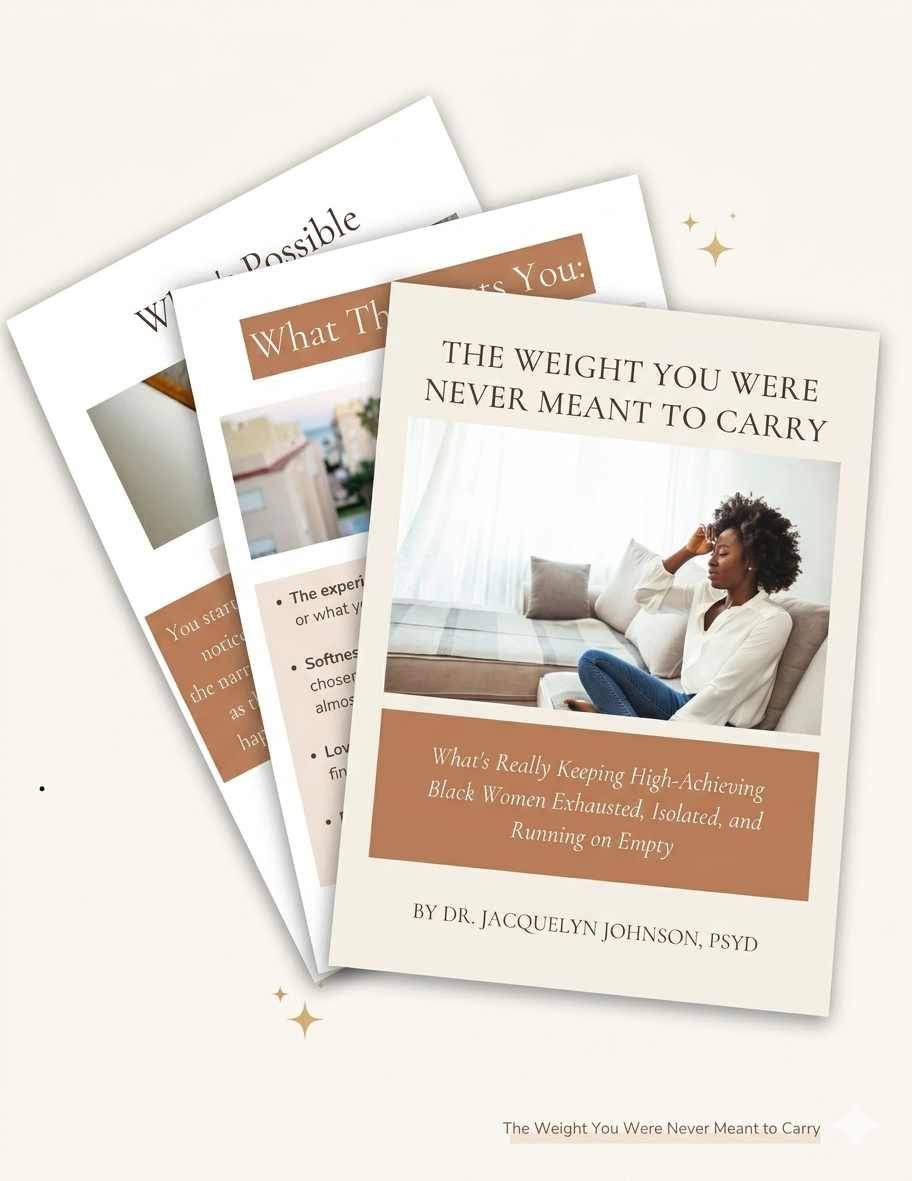
Download my free guide